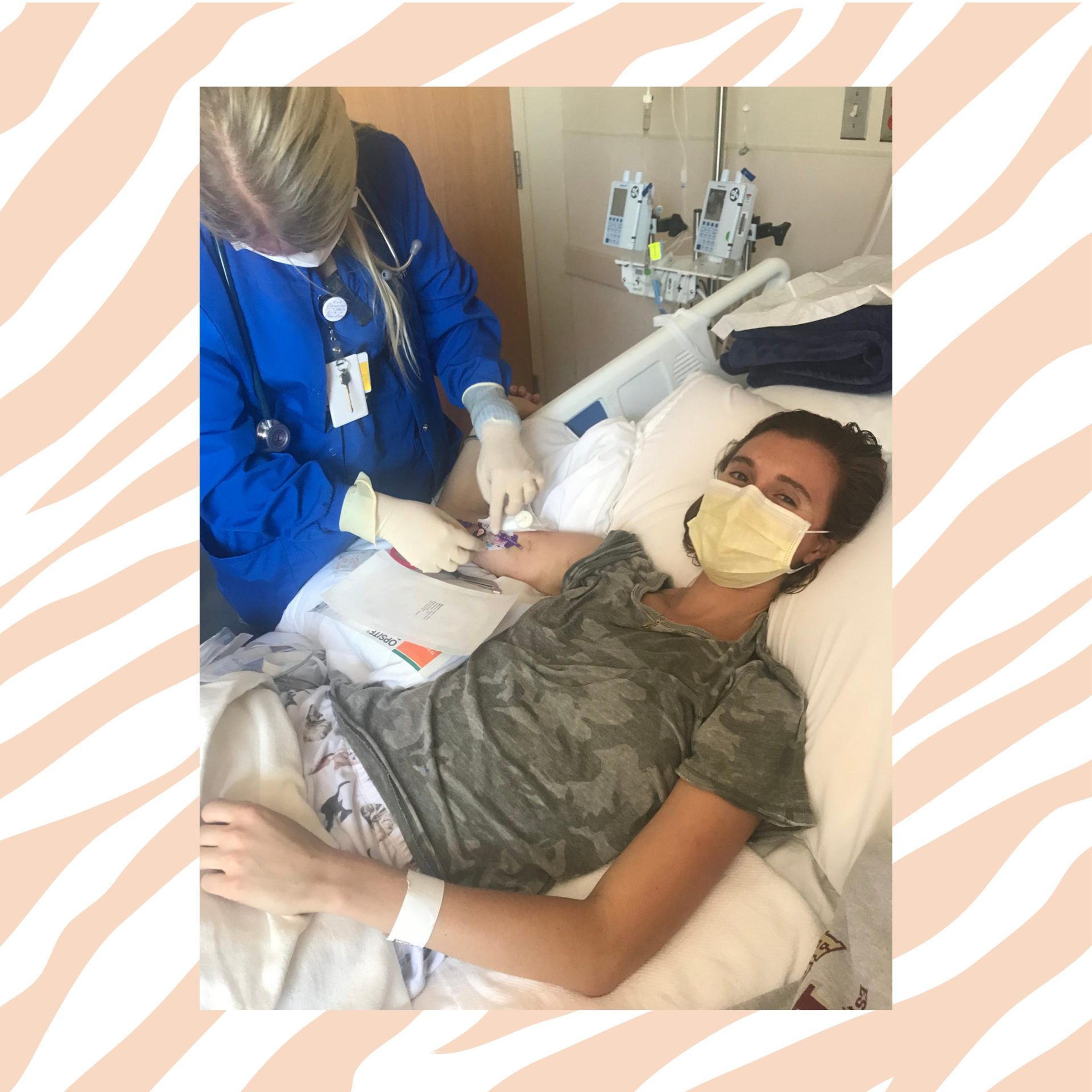
University of Notre Dame students, Jamie and Kallie, are raising awareness of Ehlers-Danlos syndrome (EDS) as part of a Patient Advocacy Initiative program. Jamie and Kallie interviewed Francie Fitzgerald, a member of the Board of Directors of The Ehlers-Danlos Society and Notre Dame Alumni, who lives with hypermobile Ehlers-Danlos syndrome (hEDS). Here, they share Francie’s story of her diagnostic odyssey and the challenges facing many struggling with the Ehlers-Danlos syndromes and hypermobility spectrum disorders.
Francie Fitzgerald was a generally healthy child, with the exception of orthopedic injuries and recurrent Strep infections, and led a very active life, becoming a triple varsity athlete with a Division I field hockey scholarship offer by her sophomore year of high school. This all came to an abrupt halt when she contracted Epstein-Barr Virus while traveling abroad to Cape Town, South Africa on a school trip. A relatively common infection, which should have resulted in a few weeks of fatigue and bed rest, led to Francie’s development of postural orthostatic tachycardia syndrome (POTS), a suspicion proposed by an infectious disease specialist at Johns Hopkins and confirmed at Children’s Hospital of Philadelphia. POTS is a form of dysautonomia, which inhibits the body’s ability to maintain homeostasis across various physiological systems. To make matters worse, she was often dismissed by doctors, who claimed that her conditions were “over dramatic” or psychological in nature, even as her condition deteriorated rapidly.
Francie began a long and arduous journey of visiting one doctor after another, who, by and large, prescribed medications and lifestyle changes in an attempt to manage her symptoms. However, she was primarily left frustrated, with little alleviation to her condition. Because of the dysautonomic nature of POTS, Francie and her family spent countless hours seeing various specialists to address her myriad of symptoms. Even having been seen by such an extensive web of physicians, it would take nearly 7 years for Francie to be given a diagnosis of hEDS, even after being told by three top US institutions that she did not, in fact, show signs of the disease.
Francie has also received diagnoses of ulcerative colitis, small fiber polyneuropathy, mast cell activation syndrome (MCAS), and many others. Her diagnosis and treatment journey has led to numerous hospitalizations, disruption to her daily life, and severe life-threatening complications from drugs and procedures.
Even with an extensive list of medical diagnoses, Francie still had, and continues to, address the environmental and psychosocial factors that amplify her symptoms, such as temperature or pressure changes, alcohol consumption, certain foods, normal hormonal fluctuations, and even the slightest sleep deprivation. She is very intentional about maintaining a daily routine to mediate the symptoms that she experiences, including a special diet, precise feeding schedule, low impact exercise, and meditation. She has had to learn to be adaptable when it comes to listening and responding to the feedback that her body gives.
After a dark period of sadness for the loss of her previous, healthy life, she has found peace and healing through cognitive therapy and supportive social networks. Ever since her EBV diagnosis, she experienced consistent interruptions in her academic journey due to her symptoms, and “crawled to the finish line” that was her college graduation. After having graduated from the University of Notre Dame in 2017, Francie went on to complete her Master’s Degree in social work, and currently works as a dialectical behavioral therapist focused on endemic chronic suicidality.
Francie has seen over 139 different doctors throughout her medical journey. She has seen first hand the lack of collaboration between the majority of physicians, which is critical in many rare and misunderstood diseases like EDS and POTS, and has unfortunately suffered the consequences of such isolation. Now, she dedicates herself as an advocate for those who have experienced iatrogenic, or medical-related, harm and medical invalidation that often befalls EDS, POTS, and rare disease patients across the board throughout their diagnosis and treatment. She is also very outspoken about the insufficiencies and gaps in knowledge surrounding her diseases, which presents a significant barrier to effective care.
Francie was invited to speak on a panel in front of representatives from the FDA to share her personal story as well as to inform about the necessity for increased research on EDS and POTS and better education for healthcare workers on these chronic diseases. Additionally, she is actively working to facilitate collaboration amongst physicians across the United States so that they may provide more robust and informed care to those living with EDS and POTS.
Francie’s story of patience, perseverance, mental and physical fortitude, and dedication to serving others that find themselves living with poorly understood chronic illnesses is truly inspiring. To say that Francie’s determination is tireless would be a vast understatement: she is a true, daily warrior, and has responded to the overwhelming challenges in her life by using her talents to be a beacon of hope to others.