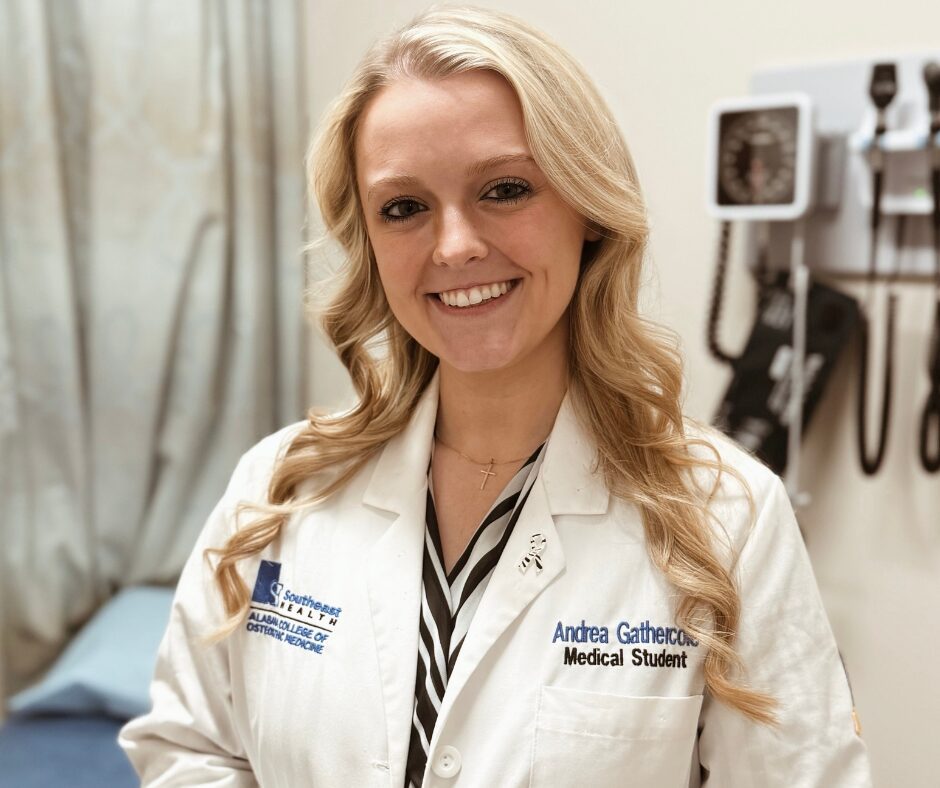
I started to see my stripes when I was learning how to recognize stripes. During my first year of medical school, I saw myself in a patient case. The stripes of symptoms the patient presented with bore a striking resemblance to the decades of struggles that various family members and I endured. The sudden realization of so many symptoms being “connected” slammed into me. Am I a zebra?
At the age of 13, I had one of my first father-daughter dates to the Retinologist. My optometrist, knowing my Dad’s retinal medical history of spontaneous three retinal detachments from a young age, kept a close eye on my retinas and referred me after finding my first few retinal tears. From there, I received ten laser photocoagulation retinal repair surgeries as new holes and tears developed throughout the years. My Dad and I always tried to schedule our appointments together. Even though the retinologist would finish with my appointment then having me hop out of the chair switching with my Dad for his appointment, genetic testing was never discussed in our care plan.
“You’ve got your Dad’s eyes, that’s for sure,” was all we got.
Being a scientifically curious person and a future physician, I wanted to know what that meant. How does lattice degeneration come about in a person genetically? At the time, my own amateur research yielded common results: lattice degeneration was genetically complicated and much of the etiology was unknown. Well, I’ll just have to keep looking. Maybe when I get a more complex understanding of the human body, I will get some answers.
I kept learning and progressing through my AP science biology classes in high school to my undergraduate degree in biochemistry, to finally my master’s in medical science, before I first heard the name “Ehlers-Danlos syndrome”.
Wow, these people have really stretchy skin! And they are very flexible! “There is an issue with their collagen, some with specific genes already specified as pathogenic, and connective tissue issues leading to them being prone to joint dislocations, and in some types, aortic dissections.” That was about as in-depth as we went in our studies.
Flash forward to a few years later, I am sitting in my first-year medical school eye neurolab when a fictional patient’s case broke my own “cold case” wide open. The patient was undergoing multiple eye surgeries for retinal tears and detachments from the ages of 12-22. Family medical history includes a parent with a similar history…. and additional sx of joint pain/abnormalities and hearing loss. His diagnosis? Stickler Syndrome, a hereditary connective tissue disorder.
Can hereditary connective tissue disorders cause retinal pathologies? I couldn’t research fast enough. So many similarities to my “stripes” riddled the web pages. My mind flashed back and connected so many things all at once: all of the retinal appointments and laser surgeries. My debilitating hip pain as a child that led to an MRI and a diagnosis of hip dysplasia. Having to edit bruises out of so many of my photos before posting them on social media. Getting spray tans and putting foundation on my chest to cover up the veins you could trace with a pen. Being hospitalized for five days for acute pancreatitis with no apparent cause besides mild gallbladder symptoms – of which they removed my gallbladder – and the not normal, atrophic scars now on my abdomen from that surgery. Is this all connected?
The main looming part that didn’t quite fit was the hypermobility part. I have never considered myself double-jointed in my fingers. We had not learned about hypermobility in a clinical setting yet in medical school. How do I even test for this? I found my answer on The Ehlers-Danlos Society page. The “Beighton Scoring System”? There, in the study room of my medical school, with the help of my medical school friends, I scored an 8/9. I was hypermobile. “I think I need to go to a Medical Geneticist.”
My primary care doctor at the time referred me after hearing my concerns, and a few months later, I was with my dad in the office with a Medical Geneticist. The main concern of our visit was the retinal problems, but we did briefly discuss my joint hypermobility. They told me a full retinal panel would be done to see if any pathogenic genes came back. I got my blood drawn and waited for the results.
Nothing can prepare someone for the disappointment that comes from hearing the words from the genetics counselor, “We could not find any pathogenic genes in all the retinal-associated genes we tested for in your blood work.” How can that be? It didn’t make any sense.
Confusion and disappointment riddled me as I asked, “There really are no genes that came up in the retinal pathology panel? What about my hypermobility?”
“The retinal pathology panel is very extensive. We didn’t run a connective tissue panel because there was some overlap between the panels. I can ask the doctor if he wants to run the connective tissue panel, but we already tested for a lot of the connective tissue issues with the retinal panel.”
“Okay. Ask the doctor what he thinks and let me know his recommendation.”
I received a message they were going to run the connective tissue panel. I am so grateful that my doctor listened to my question about whether we can test for my hypermobility. I am so grateful that I was able to advocate for myself, even knew I was hypermobile, and how to test for it, because of The Ehlers-Danlos Society website.
They called back a few weeks later with answers. “Andrea, we found 2 pathogenic variants of ZNF469 in the connective tissue panel that correlates with something called ‘Brittle Cornea Syndrome’, a type of Ehlers-Danlos syndrome. If your parents are open to it, we need them to send in samples to see if you inherited the variants from one or both of your parents. Even though this syndrome is definitively diagnosed if it is inherited in an autosomal recessive pattern, these variants are showing signs in the literature of actually being autosomal dominant in nature and presenting various EDS symptoms in carriers, and not just corneal issues.”
I called my parents so fast. They submitted their samples, and we waited again. The call came a few weeks later.
I am a zebra, my stripes definitively being Brittle Cornea Syndrome (BCS), a type of Ehlers-Danlos syndrome, the first diagnosis of BCS in my medical genetics clinic’s history. My dad was a zebra, being a carrier of a pathogenic variant of ZNF469 that was showing some autosomal dominance characteristics and correlated heavily with eye pathologies in its presentation.
And… my mom was also a zebra, being a carrier of a pathogenic variant of ZNF469 that was showing autosomal dominance characteristics and correlated heavily with a more vascular EDS-like presentation of symptoms and pathologies. My mom has extensive varicose veins, hypermobility, hernias, and a history of a postpartum hemorrhage that almost took her life.
“You definitely have your mom’s legs.” I remembered hearing from one of my family members when my mom and I were comparing our varicose veins.
I received a pathogenic variant of ZNF469 from each parent and was autosomal recessive. My cold case was solved. My parents’ cold cases were solved. It all, finally, connected.
Equipped with answers, my family and I are learning so much about how to better manage our health, symptoms, and lifestyle to accommodate our lives with EDS. From how to exercise, to preventative heart and eye screenings, to learning how to live our best and healthiest lives alongside our connective tissue disorder is possible through the work of organizations like The Ehlers-Danlos Society.
It was the years of scientific advocacy, research, and discovery for patients in the EDS community to finally have some life-changing and life-saving answers. As we look ahead, it is important that we continue this momentum to find even more genes, comorbidities, and alternative lifestyle changes. Additionally, it is important that we educate, advocate, and promote methods for uncovering EDS to those on the front lines: medical professionals.
Even in the countless doctors’ offices and specialists I have seen throughout my life, it took my personal journey of becoming a medical professional to connect, research, advocate, and discover my stripes. With my efforts no longer going to detective work, I am now able to bring my efforts towards advocacy of hereditary connective tissue disorders to medical education and clinical landscapes.
While I am still in medical school, I am working to change the landscape of medical education by advocating for representation and clinical skills training on connective tissue disorders, where the foundation of scientific knowledge is formed: in medical school. Equipping all of our future physicians, no matter what specialty they go into, with the skills and confidence in recognizing potential connective tissue disorders and giving appropriate medical genetics referrals can, and will, change and save lives.
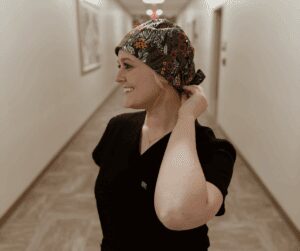
Ready to help my patients in scrubs and my zebra scrub cap.
We’ve all heard in the medical field, “If you hear hoofbeats behind you, think of horses and don’t expect to see a zebra.” Unfortunately, many clinicians only recognize a patient is a zebra in retrospect; after the patient has pieced it together themselves, finding the “right” provider, and finally receiving a diagnosis. This often follows years of misdiagnoses, repeated consultations with multiple providers, and relentless self-advocacy. By then, patients may have endured decades of harm from EDS and its comorbidities, sometimes affecting multiple generations within a family.
We need to train clinicians, and future clinicians, not only to listen for hoofbeats, but to distinguish among them. Even when horses and zebras sound similar, there are subtle differences. Through clinical skills testing, education, and continued research into evidence-based practices, we can learn and teach others how to recognize the distinct sound of a potential connective tissue disorder, the zebra’s hoofbeat, without having to turn around. Clinicians should not have to “look back” in hindsight to tell the difference.
My name is Andrea Gathercole.
I am an osteopathic medical student.
I have the Brittle Cornea Syndrome type of the Ehlers-Danlos syndrome.
I am a zebra.
And I am using my voice, my story – my hoofbeats – to teach future physicians how to spot stripes.