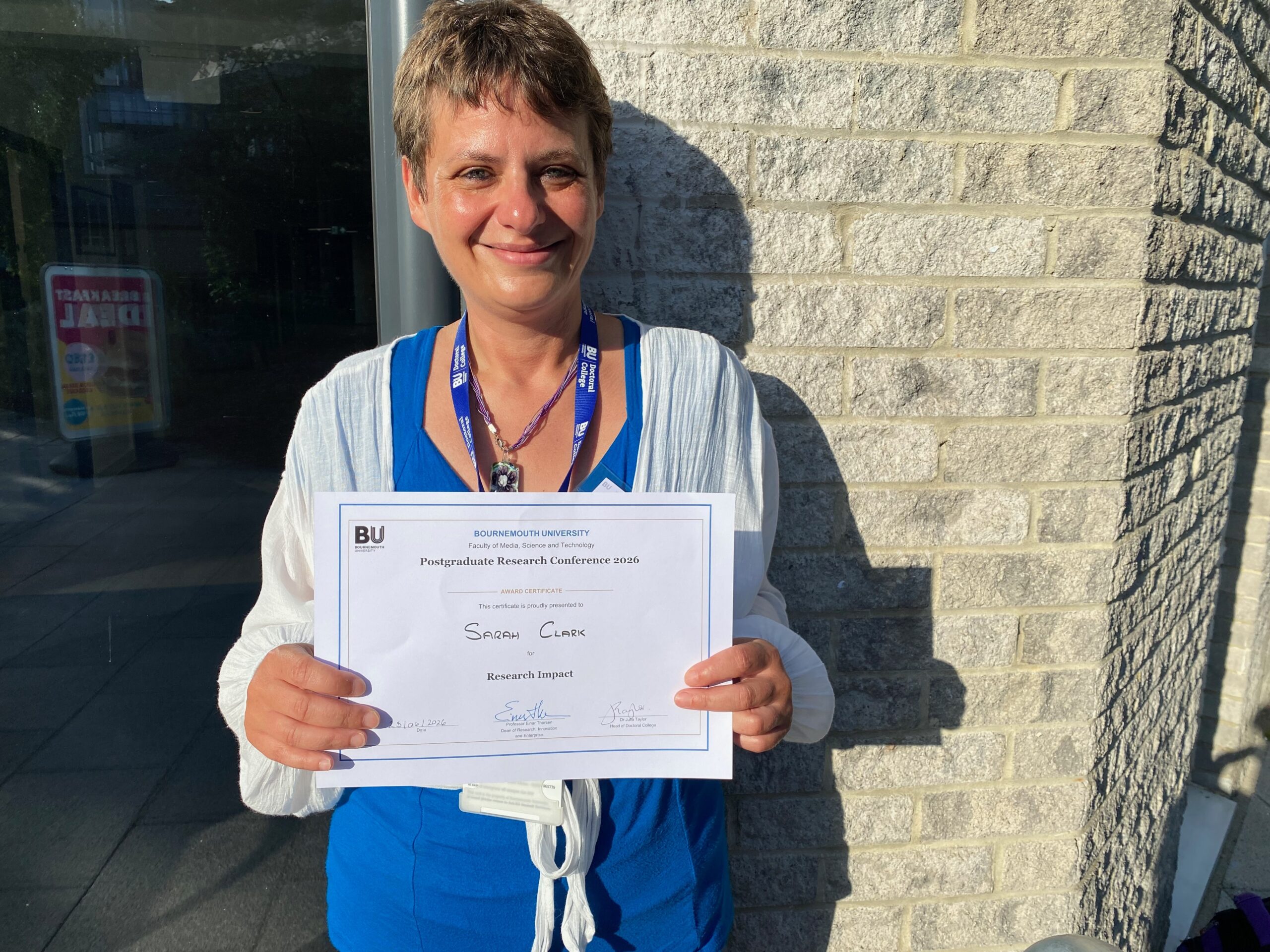
I am proud to share that I was awarded the Research Impact Award at Bournemouth University’s Faculty of Media Science and Technology Postgraduate Research Conference this week, recognizing both my postgraduate research and my wider public engagement activities.
I am currently completing a part-time MRes exploring how diagnostic delays for autistic people with Ehlers-Danlos syndromes (EDS) and hypermobility spectrum disorders (HSD) can be reduced. Alongside my research, I am passionate about translating findings beyond academia through conference presentations, publications, blogs, photography exhibitions, public engagement, delivering training and my patient advocacy work to help improve understanding and healthcare for neurodivergent people and those living with a type of EDS or HSD.
My academic journey has not always been straightforward. I completed my MSc in Clinical and Developmental Neuropsychology part-time before progressing to my MRes, balancing my studies alongside complex health conditions. Being both a lived experience researcher and an “unwell” researcher brings unique rewards, but also significant challenges as I balance my research around frequency hospital admissions, sometimes even doing uni work whilst in hospital!
Over the past 18 months, I have undergone multiple abdominal surgeries, including MALS decompression surgery last March in London, followed by another laparoscopic operation later that year. When my abdominal pain unexpectedly returned last December, I was forced to interrupt my MRes for two months while receiving inpatient treatment. Next week, I will undergo another radiofrequency ablation procedure and will once again need to pause my research studies to recover.
Managing participant recruitment, research timelines, and academic deadlines around multiple surgeries, periods of ill health and recovery has been one of the greatest challenges of my postgraduate degree. It has taught me that pacing, careful time management, flexibility, and self-management are not simply wellbeing strategies—they are essential skills for sustaining an academic career while living with a chronic condition.
The Ehlers-Danlos Society has played an important role in my development as a researcher. I have been invited to present at three Society conferences which have significantly helped improve my confidence and communication skills. Through participating in several EDS ECHO programs, including receiving a scholarship to the EDS ECHO Healthcare Students Program two years ago, and through my role as a Patient Expert within the International Consortium on EDS and HSD (Psychiatric and Psychological Aspects Working Group), I have gained invaluable knowledge, confidence, and opportunities that have directly informed my research.
Alongside this, my work as a lived experience Oliver McGowan autism trainer has further strengthened my understanding of neurodivergence, communication, and healthcare inequalities.
Receiving this Research Impact award feels especially meaningful because it recognizes not only the research itself, but also the persistence required to continue contributing to research while living with EDS. I hope my work contributes, in some small way, to improving earlier diagnosis, reducing healthcare inequalities, and ensuring autistic people with EDS or HSD are better understood in the future.