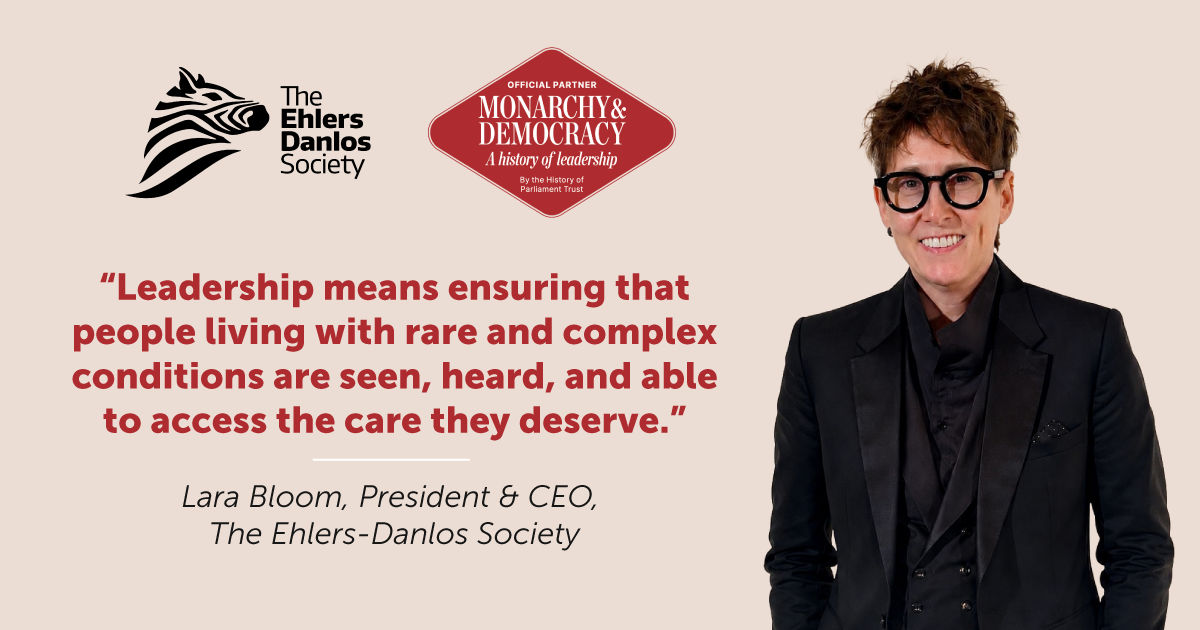
The Ehlers-Danlos Society is proud to announce that Professor Lara Bloom, President and CEO, has been featured in Monarchy and Democracy: A History of Leadership, a landmark publication produced by the History of Parliament and St James’s House.
The publication forms part of a global commemoration marking the centenary of the birth of Queen Elizabeth II and explores leadership, governance, innovation, and social impact across the United Kingdom and Commonwealth over the last century. It brings together perspectives from leaders whose work is helping shape the future of society, public service, healthcare, education, and community engagement.
As part of the project, Lara participated in an interview exploring the growing role of charities and patient-led organizations in advancing research, strengthening medical education, improving healthcare, and ensuring that lived experience informs decision-making. Lara has also been invited to attend the official launch of the publication at Westminster Abbey in London on June 9, 2026.
The Ehlers-Danlos Society was invited to participate in recognition of its contribution to advancing research, medical education, advocacy, global collaboration, and patient partnership for people living with the Ehlers-Danlos syndromes (EDS) and hypermobility spectrum disorders (HSD).
For more than a decade, The Society has worked to improve the lives of people affected by these conditions. Founded on the principle that people living with these conditions should help shape the future of research, education, and care, the Society has become a leading global voice for patient partnership and collaboration.
Today, the Society supports international research programs, delivers medical education for healthcare professionals, develops clinical resources and educational tools, advocates for system-level improvements in care, and ensures that lived experience remains central to scientific and clinical progress.
Professor Lara Bloom said “It is a tremendous honour to contribute to this publication and to represent not only The Ehlers-Danlos Society, but the global EDS and HSD community. Real progress happens when communities, clinicians, researchers, educators, policymakers, and advocates work together.
“For people living with a type of EDS or HSD, there is still much work to do. Too many continue to face delayed diagnosis, fragmented care, and barriers to support. We remain committed to driving the collaborations, research, education, and healthcare system improvements needed to create a future where everyone affected by these conditions is understood, diagnosed sooner, and supported more effectively.”